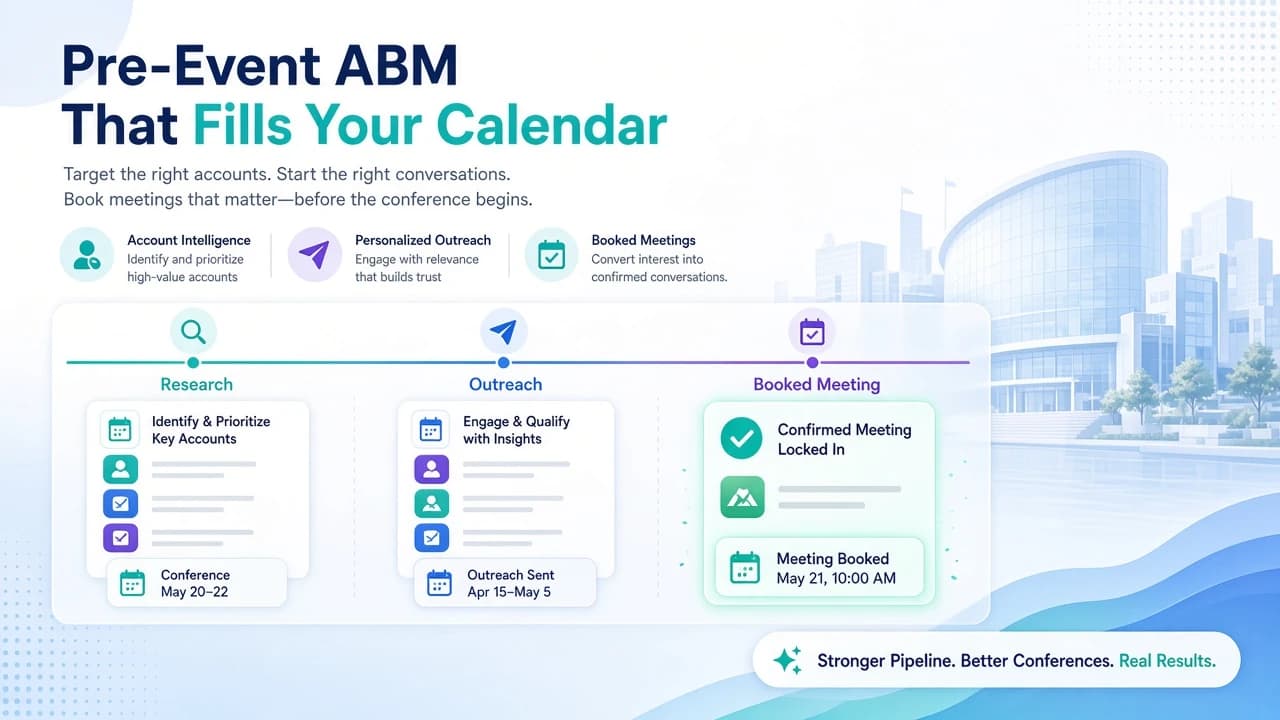
Pre-Event ABM for Conferences: Book Meetings Early
Most teams still treat conferences like lead lotteries. They ship a booth, scan badges, and hope the pile turns into pipeline. Pre-event ABM for conferences flips that model. You pick the accounts that matter, book meetings weeks before doors open, and walk onto the floor with a calendar that already looks like a revenue plan.
If you run demand gen or sales for a B2B team, this is the motion that separates a productive show from an expensive trip. Below is a practical system you can run for your next event, plus free Conference Hero tools to keep the work organized.
Why pre-event ABM beats booth-only lead gen
Badge volume looks impressive in a debrief slide. It rarely predicts closed-won revenue. Account-based conference work starts with a named list: ICP accounts already on your roadmap, customers in renewal or expansion windows, and warm opportunities that need a face-to-face push.
Industry playbooks for 2026 keep repeating the same pattern. Teams that treat events as pipeline programs book most of their high-value meetings before travel. Teams that wait for aisle traffic spend show days reacting instead of selling.
You control who you meet, not who happens to walk by.
Multi-threaded outreach reaches buying committees, not a single badge scan.
Sales shows up briefed, so conversations start mid-funnel instead of cold.
Post-event follow-up references a real meeting, which lifts reply rates.
For the full capture lifecycle once you are on site, see our guide on how to capture leads at conferences in 2026. Pre-event ABM is what fills the calendar before that system kicks in.
Build a conference target account list that sales will use
Start eight to twelve weeks out. Pull predicted or registered attendees when the organizer publishes them. Match that list against your CRM, intent data, and open opportunities.
Split the list into three buckets so outreach stays honest:
Net-new ICP accounts (about half the list). Fit your firmographic and persona filters, and are not stuck in a late-stage deal already owned by another event.
Customers in renewal or expansion (about a third). Use the conference for executive face time, reference harvests, and churn risk briefings.
Active opportunities (the rest). Prospects mid-evaluation who benefit from a live demo, customer dinner, or technical deep dive.
Cap the working list. A focused set of 40 to 80 accounts with clear owners beats a bloated spreadsheet nobody touches. Assign an AE or SDR to each Tier 1 account and write one line on the meeting goal: discovery, demo, multi-thread intro, or expansion QBR.
The eight-week pre-event ABM cadence
Treat outreach like a campaign with a finish line, not random LinkedIn notes the week before travel.
Weeks 8 to 6: research and first touch
Confirm who from each account is likely attending. Map titles across economic buyer, champion, and technical evaluator. Open with a short, specific note that names the event, a relevant session, or a mutual connection. Offer a 20-minute meeting on a defined day, not a vague "let's connect."
Weeks 5 to 3: multi-channel sequence
Run a light three to five touch mix: email, LinkedIn, and for Tier 1 accounts a short Loom that references their stack or a shared customer. Invite the right people to a customer dinner or small side event when that format fits. Keep the ask concrete: calendar link, two time options, or a booth slot.
Weeks 2 to 1: confirm and brief
Lock meetings on AE calendars. Aim for roughly 70% of priority slots filled before you fly. Build one-page account packs: why they matter, open opportunities, known objections, and the next step you want from the meeting. Brief booth staff so aisle conversations reinforce the same story.
Need a timeline you can hand to marketing and sales? Use the free Conference Prep Checklist to generate a role-based plan for your team size and booth setup.
Meeting goals and offers that actually get accepted
Generic "grab coffee at the booth" invites get ignored. Stronger offers feel useful to the buyer:
A 20-minute working session on a problem they already named in a prior call.
A customer-led peer chat (not a product pitch) with an account in their industry.
A technical deep dive with your solutions engineer while their evaluator is on site.
A short executive briefing for renewal-risk customers who need air cover.
Track acceptance rate by offer type. After two events you will know whether dinners, booth demos, or private briefings convert for your ICP.
Connect pre-event work to CRM and ROI
Every booked meeting should exist as a CRM activity or campaign member tied to the event before you leave. Tag the conference as the source. When opportunities move later, finance can see influence without a spreadsheet archaeology project.
Before you finalize spend, run the numbers with the free Conference ROI Calculator. Model expected meetings, conversion, and pipeline so the ABM investment has a baseline. Pair that with your broader measurement approach in the conference ROI tracking guide.
Staffing and handoffs once the show starts
Pre-event ABM only pays off if the floor team protects booked time. Block AE calendars for confirmed meetings. Give engagers a short qualification script for walk-ups so demos stay reserved for warm and hot visitors. Capture notes the same day, then route Tier 1 follow-up within 48 hours.
If your bottleneck is turning attendee data into outreach earlier in the funnel, the conference lead generation guide covers list-to-pipeline workflows that sit beside this ABM motion.
Common pre-event ABM mistakes to avoid
Even strong teams leak pipeline in predictable places. Watch for these traps when you run pre-event ABM for conferences.
Starting too late. A LinkedIn blast five days before travel is not ABM. You need weeks for multi-threading and calendar chess.
List bloat. Two hundred "nice to meet" accounts with no owners produce noise. Prefer a smaller list with clear meeting goals.
Ignoring customers. Expansion and renewal conversations at events often pay faster than cold net-new meetings.
No CRM tagging. If meetings are not tied to the event campaign, ROI debates turn into opinions.
Booth team unbriefed. Pre-booked meetings fail when aisle chaos steals AE time or staff do not know the account story.
Write the failure modes into your runbook. Review them in the kickoff so marketing and sales share the same guardrails.
A simple scorecard for your next event
Keep the metrics few and revenue-adjacent:
Target accounts researched and owned
Meetings booked before travel (and fill rate vs. goal)
Showed-up rate for those meetings
Opportunities created or advanced within 30 days
Cost per ICP meeting vs. prior events
Share the scorecard with sales leadership before the show so everyone agrees what success looks like. After the event, compare projected vs. actual with the same calculator inputs you used up front.
Start with one conference, not a theory deck
Pick your next high-fit event. Build a 50-account list this week. Launch a short sequence with clear meeting offers. Brief the booth team with account packs. Measure meetings and pipeline, not scans.
Pre-event ABM for conferences is not more busywork. It is how B2B teams turn travel budgets into planned conversations with the accounts that already matter. Use the checklist and ROI tools above, keep the cadence tight, and walk into your next show with a calendar you can defend.