Most teams treat conference lead generation as a booth problem. The quieter play is simpler: work the public attendee, speaker, and sponsor lists with enrichment and sequenced outreach, whether or not you ever set foot on the show floor.
This playbook is about turning those lists into pipeline. You will source contacts from event pages, enrich them, segment by intent, and run pre-event and post-event sequences that reference the conference as shared context. For on-site badge capture and booth tactics, use our companion guide on how to capture leads at conferences in 2026.
Why conference lead generation from lists beats cold outbound
Conference lead generation works because the list already carries intent. People registered for a topic, company, or role cluster that overlaps your ICP. That is warmer than a purchased database with no event context.
Industry research keeps pointing the same direction: in-person and hybrid events remain a top pipeline channel for B2B marketers, and event-sourced opportunities often convert at higher rates than generic paid digital leads. The catch is coverage. A booth might touch a small slice of relevant attendees. The published speakers page, sponsor directory, agenda, and (when available) attendee directory cover far more of the room.
| Factor | Cold prospect list | Conference attendee list |
|---|---|---|
| Intent signal | None or inferred | High: they registered for a relevant industry event |
| Recency | Varies | Tied to a real date on the calendar |
| Shared context | None | The conference itself (natural opener) |
| Data freshness | Decays quickly | Often verified by organizers for the event cycle |
| Cost to assemble | Paid data or SDR hours | Public pages plus enrichment time |
You do not need to attend to run this system. Some of the strongest conference lead generation programs are remote-only: list, enrich, sequence, book meetings, measure.
Where to source public attendee and participant data
Not every event publishes a full attendee directory. Most still leave useful public surfaces:
- Speakers and agenda pages: name, title, company, bio, session topic, sometimes LinkedIn
- Sponsors and exhibitors: company, booth, often a primary contact or marketing URL
- Attendee directories: full lists when the organizer makes them public or login-gated to registrants
- Networking apps: platforms such as Brella, Grip, or Swapcard when profiles are visible to participants
From those pages you can usually collect full name, job title, company, website, bio snippets for personalization, session topics, and social links. Speakers and sponsors skew toward decision-makers, so start there when the attendee directory is thin.
Practical sourcing rules for 2026:
- Prefer official event domains over random third-party scrapes of old PDFs.
- Capture the event name and year on every row so CRM attribution stays clean (see the conference ROI tracking guide).
- Respect login walls and terms of use. If you are a registrant with directory access, export only what you are allowed to use for legitimate business outreach.
- Deduplicate early. The same VP often appears as speaker, sponsor contact, and attendee.
Enrichment: turn names into workable contacts
A raw list without email or LinkedIn is a research pile, not a pipeline source. Enrich in this order:
- Identity match: confirm the right person at the right company (title + company + headshot when available).
- Professional email: find and verify work emails; suppress role accounts when you need a person.
- LinkedIn URL: required for connection-based touches and title checks.
- Firmographics: employee band, industry, region, tech stack signals if you use them in ICP scoring.
- Conference context fields: session topic, speaker vs attendee vs sponsor, priority tier.
Tools such as Apollo, Hunter, or your CRM enrichment credits work fine at small volume. At scale, list collection and enrichment should not be a week of intern copy-paste. Conference Hero is built to pull structured conference lists, keep event context on each contact, and hand sales a list ready for outreach instead of a messy spreadsheet.
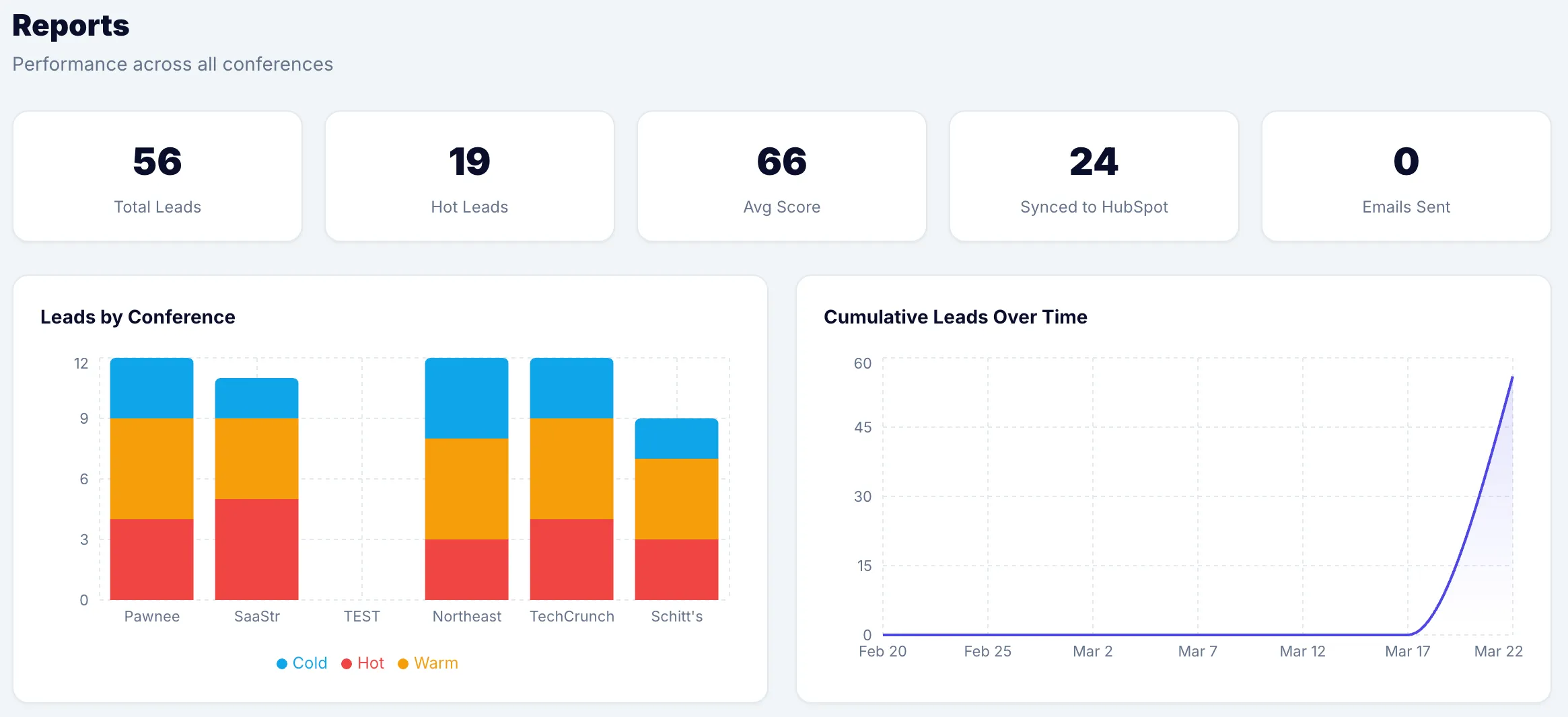
Target output columns: name, title, company, email, LinkedIn, conference name, role at event, tier, and a one-line personalization hook (session title or sponsor category).
Segment before you write a single email
Tier 1: Speakers, panelists, and sponsor contacts who match ICP. Highest visibility and usually strongest personalization angles.
Tier 2: Attendees with ICP title and company fit, no stage presence.
Tier 3: Adjacent roles worth a lighter nurture sequence.
Also segment by timing:
- Pre-event (2-4 weeks out): meeting asks, speaker congratulations, sponsor peer outreach
- During event: short, time-bound notes if you are also on-site or booking virtual follow-ups
- Post-event (1-5 days after): recap hooks, session references, soft CTA to continue the conversation
Outreach sequences that use the conference as context
You are not sending generic cold email. Reference the event early, keep claims specific, and ask for a clear next step.
Pre-event sequence (example)
- Day 1 email: mention their session or registration, one line on why you are reaching out, ask for 15 minutes before or during the week of the show.
- Day 3 LinkedIn: connection note that cites the conference, not a pitch deck.
- Day 7 email: add a concrete reason to meet (benchmark, customer story in their vertical, or a short teardown of a problem the agenda highlights).
- Day 12 bump: one sentence plus calendar link; stop if no engagement.
Post-event sequence (example)
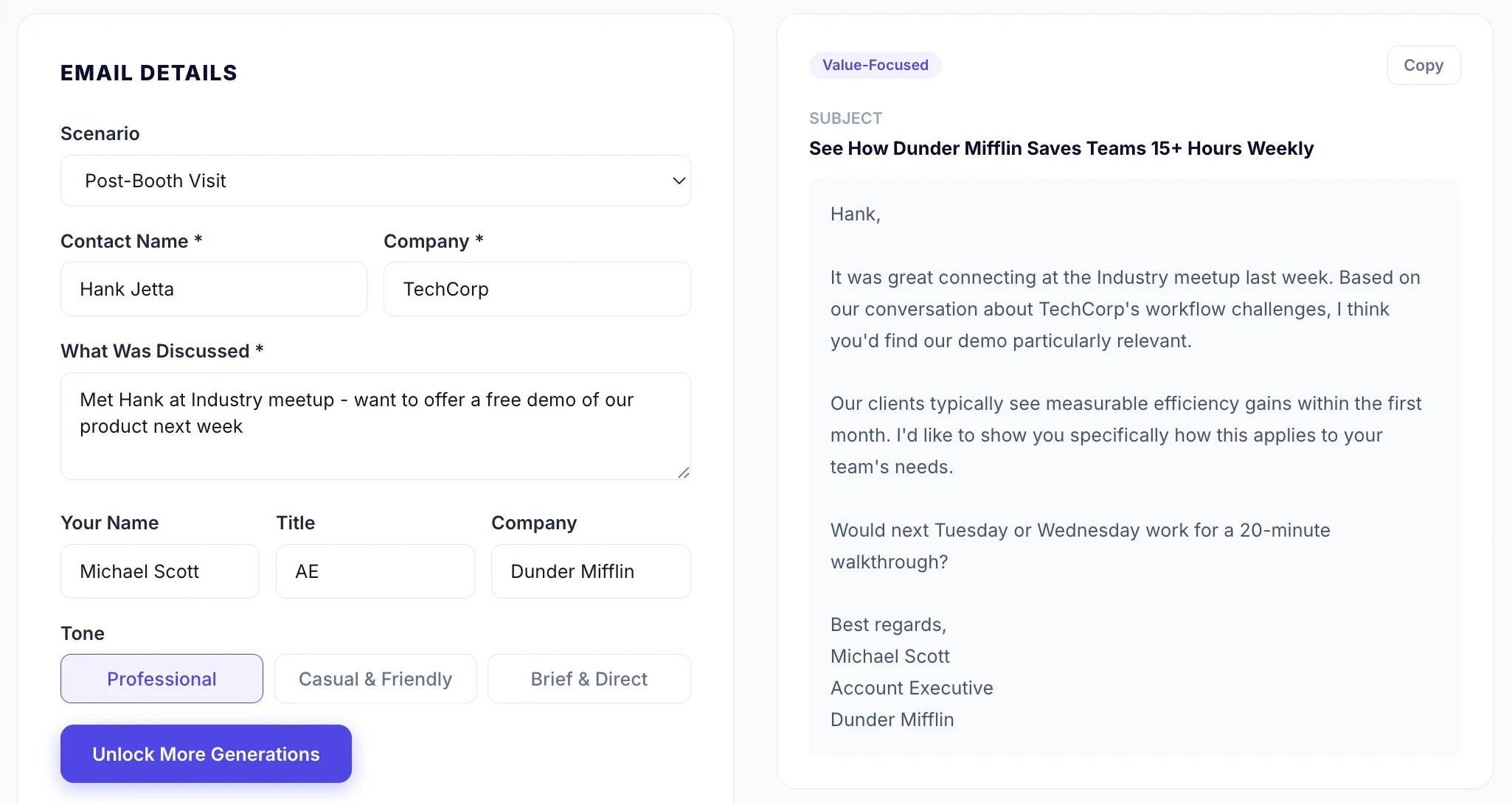
- Within 48 hours: reference a theme from the agenda or their talk; offer a specific resource.
- Day 4: case study or metric relevant to their title.
- Day 9: breakup or soft nurture redirect.
Draft faster with the free Conference Email Generator, then edit so every message sounds like a human who actually looked at the agenda.
Compliance and list hygiene (do not skip)
- Honor CAN-SPAM / GDPR / CASL basics: clear identity, unsubscribe, lawful basis where required.
- Verify emails before large sends; high bounce rates burn domains and waste conference context.
- Suppress existing opportunities and customers unless the sequence is intentionally account-based.
- Store
conference_sourceand capture method asList outreachso ROI reports stay honest.
Measuring list-based conference lead generation
Track the channel separately from booth scans:
- Contacts sourced from list vs on-site capture
- Positive reply rate and meetings booked per event list
- Opportunities and pipeline tagged to the conference
- Cost of enrichment and tools versus pipeline created
When you are ready to prove spend, plug outcomes into the ROI calculator and the field checklist in the conference ROI tracking guide.
A simple operating cadence
- Pick 1-2 ICP-aligned conferences per quarter (you can work lists without attending).
- Source speakers, sponsors, and attendees into one sheet or Conference Hero list.
- Enrich, tier, and tag the event name.
- Launch pre-event sequences 2-4 weeks out; reserve a post-event sequence template before the show starts.
- Push meetings and opportunities into the CRM with event properties filled.
- Review reply rate, meetings, and pipeline at 14 and 30 days.
That is conference lead generation as a repeatable system: public lists, enrichment, sequencing, and measurement. Pair it with disciplined on-site capture when you do exhibit, and keep both streams attributed so finance sees the full picture.
Ready to stop rebuilding spreadsheets for every show? Start on the Conference Hero homepage or jump straight to the conference email generator for your next sequence.