
Why Conference Budget Planning Still Frustrates Marketing Teams
If you've ever tried to justify conference spend to your CFO using a patchwork of receipts, Slack messages, and half-remembered vendor quotes, you're not alone. A free conference budget calculator can change that - but most teams still don't have one. They rely on gut estimates, last year's numbers plus 10%, or worse, no plan at all.
Conference attendance remains one of the highest-ROI activities in B2B marketing. According to Bizzabo's 2025 Event Marketing Report, 87% of B2B marketers consider in-person events critical to their company's success. Yet the same report found that nearly half of marketing teams struggle to accurately forecast event costs before committing budget.
The result? Blown budgets, last-minute cost cuts that undermine ROI, and leadership teams that lose confidence in event investments. Let's break down why this happens - and how to fix it with a structured approach to conference budget planning.
The 5 Biggest Pain Points in Conference Budget Planning
1. Hidden Costs That Blow Up Your Forecast
Booth fees and flight tickets are easy to estimate. But what about drayage, electrical hookups, lead scanner rentals, after-hours hospitality suites, or last-minute print runs? These "invisible" line items can add 20–40% to your total conference cost if you don't plan for them.
2. No Standardized Framework Across Events
Most teams budget differently for every conference. One event gets a detailed spreadsheet; another gets a back-of-napkin estimate. Without a repeatable framework, you can't compare performance across events or learn from past mistakes.
3. Difficulty Benchmarking Against Peers
Is spending $45,000 on a single trade show reasonable for a 50-person SaaS company? What about $120,000? Without industry benchmarks, marketing leaders are guessing - and finance teams are skeptical.
4. Misalignment Between Marketing, Sales, and Finance
Marketing wants brand presence. Sales wants meetings. Finance wants cost control. When each team operates with different assumptions about what a conference "should" cost, approval cycles drag on, and critical deadlines get missed.
5. Post-Event ROI Is Nearly Impossible to Calculate
If you don't know exactly what you spent - broken down by category - you can't calculate cost-per-lead, cost-per-meeting, or true event ROI. And if you can't prove ROI, next year's budget is at risk.
The Solution: A Free Conference Budget Calculator
We built a free conference budget calculator specifically for B2B marketing teams, revenue operations professionals, and sales leaders who attend conferences and need to plan smarter. It's available now at conferencehero.ai/conference-budget-calculator.
The tool helps you do three things:
Estimate your total conference cost — with nothing left out
See a detailed breakdown by category — so you know exactly where money goes
Benchmark against similar teams — based on company size, industry, and event type
You can use it directly in your browser, or download the results as a free Excel or PDF template to share with your team and finance department.
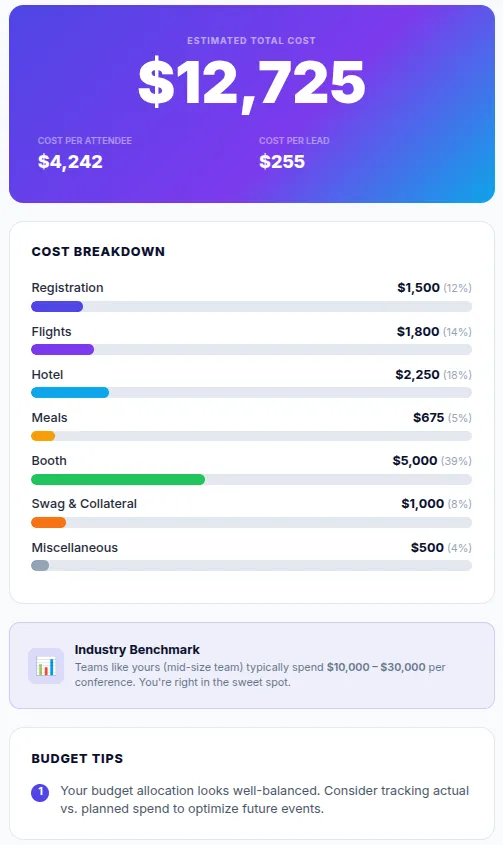
What the Conference Budget Calculator Covers
The calculator walks you through every major cost category so nothing slips through the cracks. Here's a complete breakdown of what's included:
Budget Category | Example Line Items | % of Typical Budget |
|---|---|---|
Booth & Sponsorship | Booth space, sponsorship tier, badge scans, lead retrieval | 30–40% |
Travel & Accommodation | Flights, hotels, ground transport, per diems | 20–30% |
Booth Design & Logistics | Booth build, shipping, drayage, electrical, internet, AV | 15–20% |
Marketing Collateral | Banners, brochures, swag, demo equipment, giveaways | 5–10% |
Hospitality & Meetings | Dinner events, happy hours, meeting room rentals, coffee meetings | 5–15% |
Staff & Opportunity Cost | Team hours, pre-event training, on-site labor | Often overlooked |
Contingency | Unexpected expenses, last-minute additions | 5–10% |
Key takeaway: Most teams only budget for the first two categories. The calculator ensures you account for all seven - which is how you avoid the "surprise 30% overspend" that plagues event marketing.
How Benchmarking Works
After you input your details, the calculator compares your planned spend against aggregated data from similar teams. You'll see whether your budget is above, below, or in line with peers based on:
Company size (headcount and revenue range)
Event type (major trade show vs. niche conference vs. user conference)
Booth size (tabletop, 10x10, 10x20, island)
Team size attending
This benchmarking data is especially valuable when presenting budgets to finance. Instead of saying "we think this is reasonable," you can say: "Our planned spend is 8% below the median for companies our size at this type of event."
How to Use the Calculator: A Step-by-Step Guide
Step 1: Enter Your Conference Details
Start by selecting the event type, location, and duration. The calculator adjusts travel and accommodation estimates based on the city's cost index - attending a conference in San Francisco costs very differently than one in Austin.
Step 2: Configure Your Team and Booth
Input how many people are attending, your booth size, and whether you're bringing existing booth assets or building new ones. This is where most hidden costs live, and the calculator flags them automatically.
Step 3: Review Your Category Breakdown
You'll get a visual breakdown showing exactly how your budget is distributed. If 45% of your spend is going to travel while your booth experience is underfunded, you'll see it immediately.
Step 4: Compare Against Benchmarks
See how your plan stacks up. Adjust inputs in real time to explore different scenarios - what if you send three people instead of five? What if you downsize the booth but increase your hospitality budget?
Step 5: Export as Excel or PDF
Download your complete budget as a free Excel template for further customization, or grab the PDF version for a clean, presentation-ready document you can share with stakeholders in your next budget review.
→ Try the free Conference Budget Calculator now
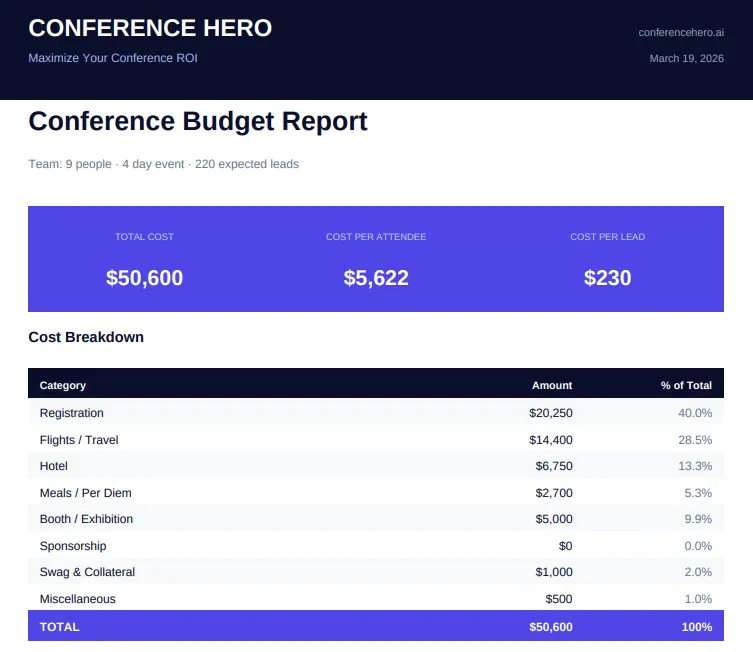
Real-World Impact: What Structured Budget Planning Looks Like
Consider a mid-market SaaS company (200 employees, $40M ARR) planning to attend 6 conferences in 2026. Without a structured approach, they might allocate $300,000 to "events" and distribute it evenly — $50,000 per conference.
With a conference budget calculator, they discover that two flagship events actually require $80,000 each (larger booths, more travel, hospitality obligations), while four smaller events can be executed effectively at $35,000 each. The total spend stays the same, but the allocation is dramatically smarter.
The result: better booth presence at high-impact events, realistic expectations for smaller ones, and a finance team that trusts the numbers because they're detailed and benchmarked.
Pair Budget Planning with Smarter Lead Generation
Knowing what you'll spend is half the equation. The other half is ensuring those dollars generate pipeline. That's where Conference Hero comes in - our platform helps conference attendees identify, prioritize, and connect with the right leads before, during, and after events.
When you combine precise conference budget planning with targeted lead generation, you can finally answer the question every executive asks: "What did we actually get from that conference?"
Teams using structured pre-event outreach generate 2–3x more qualified meetings than those who rely on walk-up booth traffic alone. Budget planning tells you how much you're investing. Lead generation strategy determines what you get back.
Start Planning Your Next Conference Budget Today
Stop guessing. Stop over-spending. Stop scrambling to justify event investments after the fact.
Use our free conference budget calculator to get a complete cost estimate, a detailed category breakdown, and peer benchmarks - then export everything as an Excel or PDF template you can share with your team in minutes.
Ready to maximize your conference ROI?
Join thousands of B2B revenue teams using Conference Hero to capture more leads, manage tasks, and prove event ROI.